
Choosing Kitchen Countertops in Vancouver: Quartz, Porcelain, Quartzite, and Granite Compared
Compare quartz, porcelain, quartzite, and granite kitchen countertops in Vancouver. Find the right surface for your home—explore options today.
September 21, 2026
A countertop decision often starts with color and ends with logistics.
You may love the look of a heavily veined slab, then learn it will need a visible seam to fit into a condo elevator. Or you may choose natural stone for its one-of-a-kind character, then realize you do not want another yearly maintenance task. In Vancouver BC, countertop fabrication is shaped by practical local details as much as personal taste: strata rules, wet weather, stair access, slab availability, and the skill required to install a large, fragile surface safely.
Quartz countertops remain the default choice in most Metro Vancouver kitchens because they are durable, consistent, and easy to live with. Porcelain countertops have gained ground with homeowners who want thin profiles, serious heat resistance, or a surface that can continue outdoors. Quartzite and granite bring natural variation that engineered materials cannot quite copy, though they ask more of the homeowner over time.
Here is how the four most common countertop materials compare, what they tend to cost, and which installation details can change a Vancouver quote.
Start With How You Actually Use Your Kitchen
Before comparing samples, think about the daily reality of the room.
Do you cook with cast iron? Do children regularly make snacks on the island? Is the kitchen exposed to strong sunlight? Are you renovating a high-rise apartment with a small elevator? Do you want a low-maintenance surface, or are you happy to care for real stone?
Those questions matter more than whether a sample looks perfect under showroom lighting.
A busy household often benefits from quartz. Someone designing a minimal, modern kitchen with an outdoor entertaining area may prefer porcelain. A homeowner who loves the irregular veining of natural stone may feel that quartzite is worth the sealing routine. Granite still has a place, particularly where heat resistance and a lower natural-stone price point matter.
There is no universal “best” material. There is only the material that fits your kitchen, budget, and tolerance for upkeep.
Quartz Countertops: The Practical Favorite
Quartz is an engineered surface made from crushed natural quartz combined with resins and pigments. It is widely used in Vancouver kitchens for a simple reason: it is forgiving.
The material is non-porous, so it does not need annual sealing. Coffee, cooking oil, tomato sauce, and wine are much less likely to become permanent stains if cleaned within a reasonable time. That is a relief in a working kitchen, especially one with a light-colored countertop.
Quartz countertops also come in a huge range of finishes. You can find clean solid whites, concrete-look grays, warm cream tones, subtle speckles, and dramatic veining that imitates marble countertops. The selection is much broader than it was a decade ago, though it is still worth looking at a full slab when possible. Small samples can hide repeated patterning or make a busy design seem quieter than it will look across a large island.
Where quartz works well
Quartz is a strong fit for most indoor kitchen counters, bathroom surfaces, laundry rooms, and vanity tops. It resists scratching under normal use and stands up well to daily cleaning.
It is also relatively predictable during countertop installation. Fabricators work with quartz every day, so stock colors often have shorter turnaround times than special-order materials. In Metro Vancouver, many fabricators in Burnaby, Surrey, and Coquitlam can template, fabricate, and install stocked quartz within roughly 10 to 18 business days.
Some locally produced engineered-stone options may move even faster, sometimes within 7 to 10 days after templating. Imported colors, specialty finishes, and backordered slabs can take longer.
Quartz limitations to keep in mind
Quartz handles normal kitchen heat, but it does not love thermal shock. The resin content means a very hot pot or cast-iron pan placed directly on the surface can scorch or crack it. A trivet is inexpensive insurance.
It is also possible to chip an edge if a heavy pan strikes it hard. This happens most often near sink cutouts, tight corners, and thin-profile edges. Chips can often be repaired, but the repair may remain faintly visible.
For outdoor kitchens, quartz is usually a poor choice. UV exposure can discolor some products or affect the resin over time. If outdoor use is part of your plan, porcelain or a suitable natural stone deserves a closer look.
Typical Vancouver quartz pricing
For a standard 3 cm quartz slab installed in Vancouver, a typical range is:
Standard quartz: about $80 to $160 per square foot
Premium veined quartz: about $130 to $220 per square foot
The final figure depends on slab yield, edge details, cutouts, access, and whether the design needs a seam. A low square-foot price can be misleading if a project requires an extra slab or complex fabrication.
Porcelain Countertops: Thin, Tough, and More Specialized
Porcelain countertops are made from refined mineral materials that are pressed and fired at extremely high temperatures. The result is a dense, hard slab with impressive resistance to heat, UV exposure, scratching, and staining.
For some kitchens, porcelain is the material that makes the design work. It can create a slim, crisp contemporary edge. It can run from an indoor kitchen to an exterior cooking area without the same UV concerns as quartz. It can also be used for fireplace surrounds, where direct heat makes material choice more serious.
Porcelain is not automatically better than quartz. It is simply different, and it demands greater care during fabrication and installation.
Why homeowners choose porcelain
Porcelain slabs are particularly appealing for large-format, modern kitchens. They can create long visual runs with minimal interruption, depending on the layout and available slab size. Some slabs have through-body color or veining, which makes cut edges less obvious. Others have a printed surface pattern, so edge treatment needs more planning.
Thin porcelain panels, including 6 mm options, can reduce weight in certain applications and work well for waterfall panels or wall cladding. Still, thin does not mean easy. A large porcelain piece can be surprisingly delicate while being moved, especially around corners, stairwells, or narrow elevators.
Unlike quartz, porcelain can generally work outdoors. It is highly resistant to sunlight and weather changes, which makes it useful for covered patios, barbecue counters, and exterior kitchen areas. Confirm that the exact product and installation method are rated for outdoor use before committing.
The tradeoff: fewer specialists and higher installation risk
Porcelain countertop fabrication requires experienced hands and specialized equipment. Vancouver has capable fabricators, but fewer shops regularly work with large-format porcelain than with quartz. That narrower pool can affect lead times and pricing.
Installation is also less forgiving. If a slab cracks during transport or placement, the replacement process can be expensive and may delay the project. Proper site measurement, cabinet preparation, handling equipment, and a clear access plan matter a great deal.
Porcelain has fewer color choices than quartz, though the category keeps improving. If you have a very exact color in mind, quartz may still give you more options.
Typical Vancouver porcelain pricing
Installed porcelain countertops generally cost about $140 to $260 per square foot. Complex waterfalls, oversized panels, book-matched layouts, full-height backsplashes, and difficult site access can push the number higher.
That upfront cost can make porcelain feel like a luxury material. For a kitchen that needs exterior continuity, slim profiles, or strong heat performance, the price can be justified. For a straightforward family kitchen, quartz often delivers better value.
Quartzite: Natural Stone With Drama and Hardness
Quartzite is a natural stone, formed when sandstone changes under intense heat and pressure. It is often confused with quartz because of the name, but the two materials behave very differently. Quartzite is quarried stone. Quartz is engineered.
Real quartzite is exceptionally hard, often harder than granite, and it has the irregular mineral patterns people expect from natural stone. A single slab can have soft clouds, sharp veining, translucent areas, or color movement that no manufactured pattern can fully reproduce.
That individuality is the point. It is also why selecting quartzite from a small sample is risky.
Buy the slab, not the sample
With quartzite, every slab is different. The best approach is to visit the slab yard and view the exact material that will be fabricated for your kitchen. Check it in natural light if possible. Look for fissures, mineral deposits, color shifts, and areas where veining may land around a sink or cooktop cutout.
A fissure is not always a defect. Natural stone often contains visible lines created during its formation. But a slab with significant movement needs a fabricator who understands how to support and cut it safely.
Quartzite is heat-resistant and durable, but it is porous. It needs sealing, usually once a year, although some sealers and specific stones may last longer. Pale quartzite can stain if spills sit for too long. This is manageable, but it is not zero-maintenance.
Typical Vancouver quartzite pricing
Installed quartzite commonly falls around $130 to $280 per square foot. Rare colors, dramatic slabs, difficult vein layouts, and book-matched islands can raise the cost quickly. Slab availability also changes often, so a design built around a specific stone should allow time for material selection.
Granite: Durable Natural Stone at a More Accessible Price
Granite has been used in kitchens for decades, and its reputation for durability is deserved. It handles heat very well, resists everyday wear, and generally costs less than quartzite.
It is no longer the automatic choice for a newly renovated modern kitchen. Many current designs lean toward calm quartz patterns, porcelain, or pale quartzite. Still, granite should not be dismissed because a few outdated styles gave it a reputation problem. A honed black granite, softly textured gray slab, or warm neutral granite can look current and restrained.
Granite needs periodic sealing, usually every 12 to 24 months. Lighter slabs need more vigilance around oil, wine, and strongly colored foods. The maintenance is not difficult, but it is real.
Typical installed granite countertops in Vancouver cost about $60 to $140 per square foot. For homeowners who want natural stone without quartzite pricing, it remains a sensible option.
Countertop Materials That Often Cause Regret
Some materials can work in narrow applications, but they are less reliable choices for a full Vancouver kitchen.
Concrete has a handmade look that many people like, but it can crack as a home moves and experiences humidity changes. Hairline cracking is often framed as part of the material’s character. That may be true, but it is frustrating if you expected a flawless surface.
Butcher block and other wood counters bring warmth, especially on a small baking station or island accent. As a full kitchen countertop, wood requires more maintenance and can be vulnerable around sinks, dishwashers, and wet Vancouver winters.
Laminate has improved in appearance, and it remains useful for tight budgets. Still, it usually does not provide the durability or resale appeal of stone, quartz, or porcelain. Solid-surface acrylic counters are seamless and repairable, but they scratch more easily and can look dated beside current cabinet styles.
Vancouver Installation Details That Change the Final Price
A countertop quote is never just material multiplied by square footage. Fabrication and delivery often determine whether a project stays straightforward.
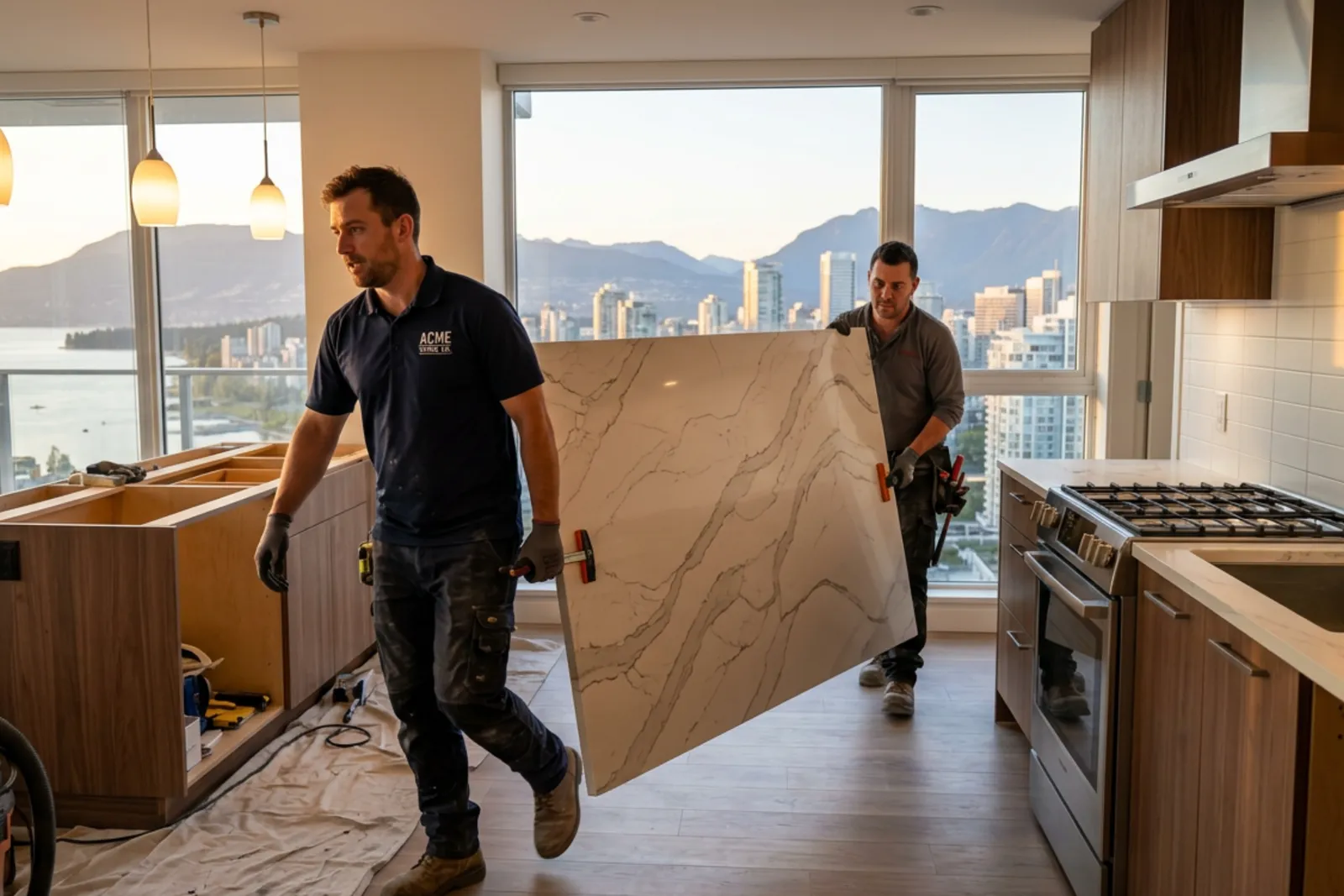
Many condominium buildings create the biggest challenge. A typical countertop slab can measure around 3 meters by 1.5 meters and weigh roughly 200 to 400 kilograms. If it cannot fit in the elevator or move through the building’s corridors, the fabricator may need to create an extra seam.
That can add roughly $400 to $800 in labor and changes the visual result. A good fabricator will place seams thoughtfully, but a seam is still a seam.
Walk-up apartments and multi-level townhomes can also add a stair-carry surcharge, commonly around $300 to $600. This is not a made-up inconvenience fee. Moving a heavy slab safely up multiple flights takes additional labor, equipment, and coordination.
Other common pricing variables include:
Basic eased or square edges are often included, while bullnose, ogee, and mitered waterfall edges may add $15 to $45 per linear foot.
Sink and cooktop cutouts often add $50 to $150 each.
A standard 4-inch backsplash may be included, while a full-height stone backsplash can add about $80 to $150 per square foot.
Seam placement, drainboard grooves, radius corners, laminated edges, and oversized islands require extra countertop fabrication time.
Digital laser templating can reduce measurement errors, especially where walls are out of square or a full-height backsplash must meet cabinets precisely. Still, no technology replaces a proper site visit and a final check of slab access.
What a Full Kitchen May Cost in Vancouver
The following ranges include standard fabrication and countertop installation, a basic eased edge, and one sink cutout. They are useful planning numbers, not substitutes for a layout-specific quote.
A small condo kitchen with about 25 square feet of counter space may cost:
Standard quartz: $2,500 to $4,500
Premium quartz: $3,800 to $6,200
Porcelain: $4,200 to $7,500
An average kitchen with around 40 square feet may cost:
Standard quartz: $3,800 to $7,500
Premium quartz: $6,000 to $11,000
Porcelain: $6,800 to $13,500
A larger kitchen with an island and about 65 square feet may cost:
Standard quartz: $6,000 to $11,500
Premium quartz: $9,500 to $17,500
Porcelain: $11,000 to $22,000
Quartzite and granite pricing vary more because each slab is unique. The selected stone, how much usable material it yields, and the amount of reinforcement required all affect the total.
A Sensible Way to Make the Final Choice
If low maintenance is your priority, quartz is hard to beat. It is practical, widely available, and suited to the pace of everyday life.
If your design needs a thin-profile surface, an outdoor kitchen extension, or a heat-resistant fireplace surround, porcelain deserves serious consideration. Just make sure the project is handled by fabricators with real porcelain experience.
If you want the visual depth of natural stone, view quartzite and granite slabs in person before deciding. Do not assume that a photo, sample chip, or online image tells the whole story.
Finally, ask every fabricator the same practical questions: Is templating included? How will the slabs get into the home? Where will seams fall? What edge details are included? Who handles removal of the old counters? What does the workmanship warranty cover?
The answers will tell you more about the real scope of the job than a per-square-foot price ever can.