
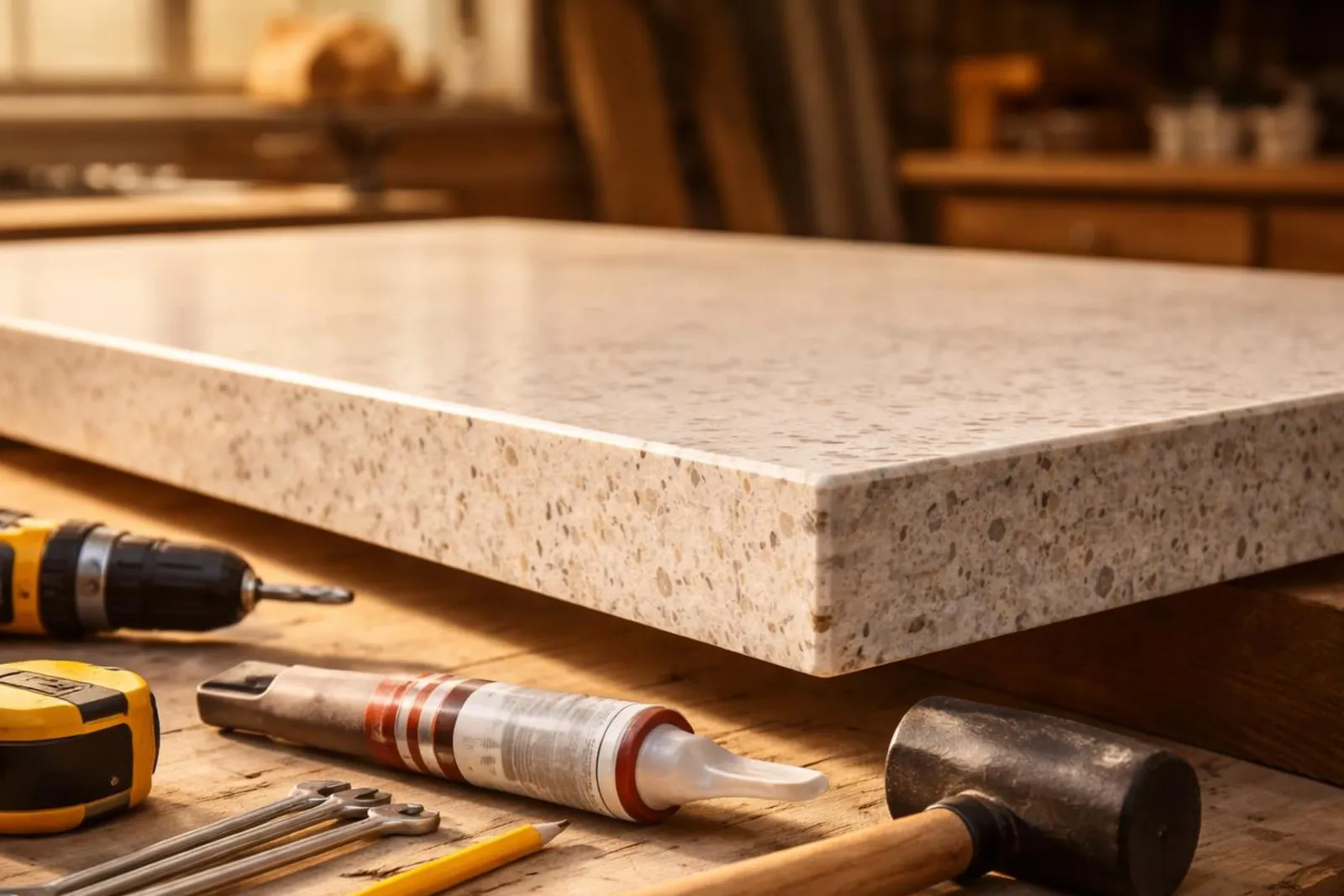
Hidden Variables That Drive Countertop Quotes
Countertop quotes vary for a reason. Learn what affects installed countertop price and compare quotes with confidence. Contact Pacific Range Countertop.
August 24, 2026
If you have ever compared countertop quotes and felt like the numbers were coming from different planets, you are not imagining it.
One company talks about slab price per square foot. Another gives a rough installed total. A third mentions fabrication, but leaves out delivery. Then you find out sink cutouts, edge work, or a difficult condo install can change the price again. It gets confusing fast.
The biggest mistake homeowners make is treating the slab price as the countertop price. It is not. A countertop is not just stone or quartz sitting in a warehouse. It has to be measured, cut, shaped, transported, carried in, fitted, and installed with care. That full chain is what you are paying for.
Whether you are looking at quartz countertops, granite countertops, marble countertops, or porcelain countertops, the quote only makes sense when you look at the installed price. That is the number that reflects the real job.
Why slab price per square foot tells only part of the story
Slab pricing is appealing because it looks simple. You see a material you like, someone gives you a per square foot number, and you assume you can multiply that by your countertop area. Clean math. Unfortunately, real projects do not behave that neatly.
A kitchen might have 45 square feet of surface area but still require more raw slab material than that. Why? Because slabs come in fixed sizes, and your pieces need to be cut out of them in a way that works for grain, veining, cutouts, and seam placement. Some pieces fit efficiently. Some do not.
That means two kitchens with the same square footage can cost very different amounts. One layout may use material very efficiently. Another may need a second slab because of a long island, a waterfall end, or a strong vein pattern that must line up.
Installed pricing is more honest because it rolls together the material and the work needed to turn that material into a finished surface in your home.
What an installed countertop quote usually includes
A proper installed quote is supposed to cover the full job, not just the slab. In most cases, that means these core items are part of the number:
The selected material, including type, thickness, and finish.
Standard countertop fabrication and finished edges.
Sink and cooktop cutouts.
Delivery to the site.
Professional countertop installation.
Final measurement review and technical confirmation before fabrication.
That does not mean every quote includes the exact same details. Some fabricators include standard sink cutouts but charge extra for additional fixture holes. Some include a basic eased edge but price upgraded profiles separately. Some include installation but not unusual access conditions.
This is where people get tripped up. A quote can sound complete while quietly relying on assumptions that may change later.
From early estimate to final installation
Most countertop projects move through four stages. The order matters because the quote usually gets more accurate with each step.
1. Planning the first estimate
At the start, the fabricator usually works from rough dimensions, a kitchen plan, or a simple layout. This first number is often a price range, not a locked final total.
That is normal. At this stage, no one has confirmed exact cabinet sizes, overhangs, sink model, or seam locations. A rough estimate is useful for budgeting, but it still has some wiggle room.
2. Selecting the material
Once you choose the material, the quote gets sharper. This is where you decide whether you want quartz countertops, granite countertops, marble countertops, or porcelain countertops, and then narrow down thickness, finish, and edge style.
Material choice changes the price more than many homeowners expect. A standard quartz may be fairly predictable. A dramatic marble or quartzite slab can vary a lot, partly because of supply and partly because vein direction and matching matter.
3. Verifying measurements and layout
This is the stage where a lot of hidden variables show up.
After material selection, the job is templated and reviewed in detail. Many shops use digital laser templating now, which helps capture exact cabinet dimensions, wall conditions, and any irregularities. That level of precision is a good thing, but it can reveal issues that were not obvious on the first visit.
Maybe the cabinets are not perfectly level. Maybe the wall bows slightly. Maybe the sink base is tighter than expected. Maybe the slab layout that looked easy on paper becomes more complex once vein direction is considered.
The final quote should reflect this verification stage.
4. Fabrication, delivery, and installation
Once the layout is approved, the pieces are fabricated, finished, transported, and installed on site. If the project is straightforward, this part can feel smooth and fast. If the jobsite is difficult, this is where labor costs climb.
A wide island top that has to be carried up stairs is different from a small vanity installed on the ground floor. Same material, very different effort.
The hidden variables that most often change countertop quotes
These are the details that push a quote up or down. Some are obvious once you see them. Others stay hidden until the job is well underway.
Slab selection and slab yield
This is one of the biggest factors, and it rarely gets enough attention.
Slab yield is the usable portion of the slab after accounting for pattern direction, defects, edge finishing, sink openings, and waste from cutting. Natural stone is especially variable here. A dramatic slab may have sections you want to avoid, or a vein pattern that forces a very specific layout.
Let’s say you need a long island and an L-shaped perimeter. On paper, the total square footage might suggest one slab is enough. In reality, vein matching or piece orientation may force a second slab. That changes the number fast.
With granite countertops and marble countertops, natural variation often makes slab yield less predictable. Quartz countertops are usually more consistent, so planning can be easier. Porcelain countertops add their own considerations because large-format slabs are thin and strong, but they still require careful handling and layout.
If a quote looks unusually low, ask what assumptions were made about slab yield. That question alone can save a nasty surprise later.
Fabrication complexity
Fabrication is where a countertop becomes your countertop.
A basic rectangular top with a simple edge is one thing. A job with mitered aprons, waterfall ends, integrated drainboards, full-height backsplashes, or tight corner details is something else entirely. Those features take more shop time, more skill, and more material.
This is especially true when the edge treatment is more involved. A standard eased edge is quick compared with a heavy mitered look designed to make a thinner slab appear much thicker. That effect can look great, but it is not a free upgrade.
Finish matters too. A polished surface is often the baseline. Honed, leathered, or textured finishes can require different handling and, in some cases, added labor.
When people compare prices, they often assume fabrication is a flat fee. It is not. Countertop fabrication is highly sensitive to detail.
Cutouts, fittings, and sink preparation
Cutouts sound small until you watch how precise they need to be.
A sink opening, cooktop opening, faucet hole, soap dispenser hole, or support detail around an appliance all require careful measuring and clean execution. Undermount sink preparation also adds work because the inside edge has to be finished properly, not just cut.
This is one reason bathroom surfaces can price differently than expected too. A small vanity top may use less material than a kitchen, but detailed faucet drilling, tight backsplashes, and custom bowl placement still take time.
The same logic applies to fireplace surrounds. They may look simpler than a kitchen at first glance, but panel alignment, edge treatment, and installation conditions can make them quite technical.
Seams and slab layout
Nobody loves seams, but most projects need them somewhere. The important question is not just whether there will be a seam, but where it will go and how difficult it is to make it look intentional.
Long runs, corner kitchens, and large islands often require seams. If the material has heavy movement or bold veining, seam placement becomes more delicate. Matching the pattern across pieces takes planning and can lead to more waste.
This matters a lot with marble countertops and some granite countertops, where the natural pattern is part of the appeal. It also matters with bookmatched or highly directional porcelain countertops.
A quote that ignores seam strategy is incomplete. You do not need every seam location finalized at the first estimate stage, but the fabricator should explain whether the current number assumes a straightforward layout or a more design-driven one.
Thickness and material type
Material choice drives cost, but so does thickness.
A thicker slab weighs more, may cost more per slab, and often requires more effort to move and install. In some cases, a thinner material with a built-up edge can create the same visual depth at a different price point. That is worth discussing early.
As a general rule, standard quartz and common granite options are often easier to budget for. Premium marble, quartzite, onyx, and specialty porcelain can cost more because the raw material is more expensive or the fabrication demands are tougher.
Porcelain countertops deserve a quick note here because many homeowners are curious about them. They are popular for good reasons, especially when heat resistance, UV stability, or large-format design matters. But pricing depends heavily on slab size, thickness, edge treatment, and the fabricator’s comfort level with the material. A shop with real experience in porcelain may price and execute it differently than one that only handles it occasionally.
Delivery and installation logistics
This is the part almost everyone forgets until install day.
A countertop is heavy, fragile in the wrong moment, and awkward to move. Access conditions matter. A lot.
If the installers have easy driveway access, a short carry, and wide doors, the job is simpler. If they are working in a high-rise in Vancouver BC, coordinating elevator time, parking restrictions, building protection rules, and a long carry through hallways, labor goes up. Fairly so.
Homes in North Vancouver and other parts of Metro Vancouver can add their own quirks too. Hills, stairs, tight entries, older walls that are not perfectly square, and multi-level layouts all affect installation effort.
This is where terms like white-glove installation actually mean something, if they are backed up by real logistics planning. Protective handling, careful transport, site coordination, and final fit all take time. That should be reflected in the quote.
Final verification can uncover surprises
Even a careful first estimate can miss things.
Once final measurements are taken, the fabricator may discover uneven cabinet heights, a wall that leans, a support issue around a cooktop, or the need for an adjustment to overhangs. None of this means anyone did a bad job. It just means real houses are rarely as tidy as plans.
This is why digital laser templating has become so common. It reduces guesswork and catches odd conditions before stone is cut. That usually saves money overall, even if it sometimes leads to an updated final quote.
I would rather see a quote change because the details were checked properly than stay artificially low until install day turns into an argument.
Typical installed price ranges in Metro Vancouver
For a standard kitchen using common materials and a straightforward layout, installed pricing often lands somewhere around $3,000 to $5,000. That is a broad range, but it is a realistic starting point for many projects.
The total usually climbs when you add any of the following:
Premium natural stone
Waterfall ends
Full-height backsplashes
Large islands
Complex seam matching
Difficult access
Thicker material or built-up edge details
Local context matters too. In Metro Vancouver, delivery distance, parking, elevator coordination, and site access can shift labor costs more than homeowners expect. A simple suburban install and a downtown condo install are not the same job.
If you are shopping in Vancouver BC or North Vancouver, ask whether the price reflects local delivery and access assumptions. It is a small question with a big payoff.
How to compare countertop quotes fairly
This is the practical part. If you want to compare suppliers on an apples-to-apples basis, ask for the installed price and ask what that number includes.
A useful quote should spell out the main assumptions. At minimum, you want clarity on these points:
Material type, slab count, thickness, and finish
Edge profile included
Sink and cooktop cutouts
Faucet or fixture holes
Seam assumptions and layout notes
Delivery and countertop installation
Site access charges, if any
Final measurement or templating process
Whether the shop uses in-house fabrication or outsources parts of the work
Any workmanship warranty terms
That last part matters more than people think. A lifetime workmanship warranty is not the same as a material warranty, and neither replaces a clear scope of work. Ask what is covered.
You can also ask a very direct question: “What is most likely to change this price after templating?” A good fabricator should be able to answer that without dancing around it.
A better way to budget before you choose a slab
There is a common emotional pattern in countertop shopping. People fall in love with a slab first, then try to force the budget to fit around it. I get it. Materials are visual. It is easy to make a heart-first decision.
But budgeting works better the other way around.
Start with an installed range for your project. Then choose materials that fit that full number, not just the raw slab price. That keeps you from getting attached to a material that only works if everything else goes perfectly.
This approach also helps with related projects. If you are planning bathroom surfaces or fireplace surrounds at the same time as a kitchen, it is smart to budget for the full fabrication and installation package across all pieces, not just material square footage.
The bottom line
A countertop quote is only useful when it reflects the actual job.
That means material, slab yield, countertop fabrication, cutouts, seams, delivery, countertop installation, and site conditions all need to be part of the conversation. Slab price alone is too thin to build a renovation budget on.
If you ask for one clear installed price, and make sure the assumptions are spelled out, you will have a much better shot at comparing suppliers fairly. More important, you will know what you are really paying for before the fabrication starts.
That is how you avoid quote confusion. And honestly, it is how you keep a beautiful countertop project from becoming a math problem halfway through.